Insights
What Is a Micro School? Micro School vs Traditional School
5 min read
A new category of school is gaining serious attention among Indian parents who have spent years watching their children move through a system that was designed for a world that no longer exists. The question — what is a micro school — is being asked with increasing frequency by families in Hyderabad, Pune, Bengaluru, and Mumbai who sense that something is missing from the conventional education model but are not quite ready to commit to full homeschooling. The micro school vs traditional school comparison sits at the centre of one of the most important educational conversations happening in India right now.
This guide answers both questions directly. What a micro school actually is, how it differs from a traditional school in structure and learning philosophy, and what specific qualities parents should look for when evaluating whether this model is genuinely right for their child.
What Is a Micro School — A Clear Definition
A micro school is a small, intentionally designed learning community — typically serving between eight and thirty students across a range of ages — that replaces the factory-model classroom with a more personalised, flexible, and child-centred approach to education. The term is relatively recent, gaining mainstream usage over the past decade, but the educational principles underlying it draw on a much longer tradition of thinking about how children actually learn versus how large institutional schools have historically required them to learn.
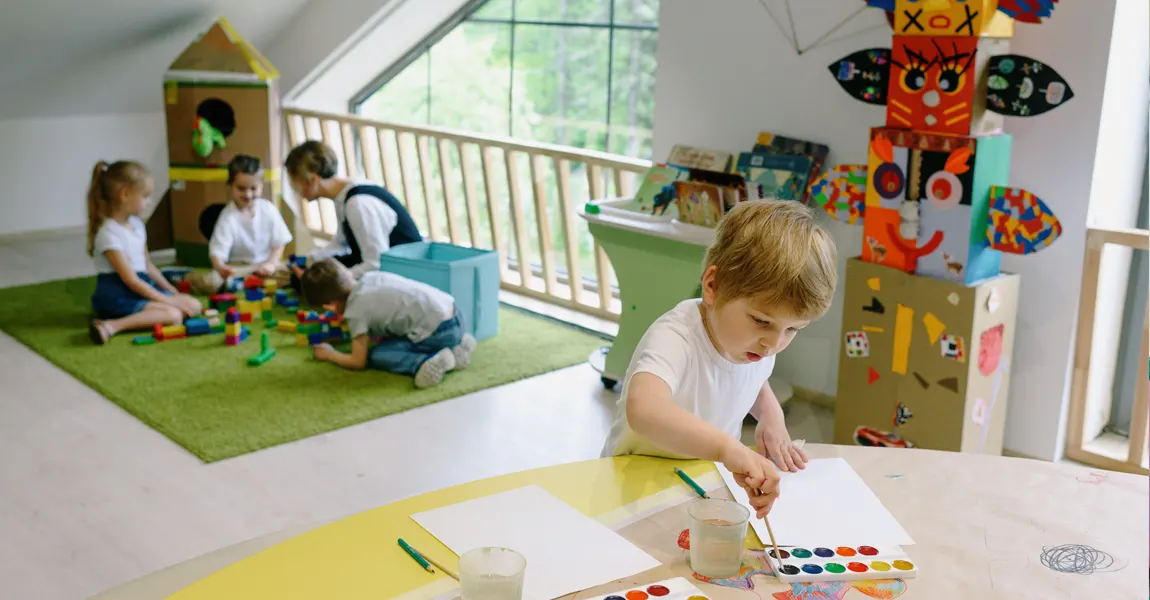
Several characteristics consistently define what a micro school is in practice. Class sizes are small enough that every child knows every teacher by name, and every teacher genuinely knows every child as an individual. The curriculum is typically more integrated and interdisciplinary than the subject-siloed approach of conventional schooling — mathematics might be explored through architecture, science through philosophy, language through storytelling that draws on every discipline simultaneously. Assessment tends to be portfolio-based and continuous rather than examination-driven, measuring what a child can actually do and think rather than what they can recall under timed conditions.
Age groupings in a micro school are often mixed rather than strictly year-based — an approach supported by developmental research showing that children benefit significantly from learning alongside peers at different stages, not just those born within twelve months of themselves. Older children consolidate understanding by explaining it to younger ones. Younger children stretch toward capabilities they see modelled by older peers. This dynamic is rarely achievable in a conventional school structure and is one of the most distinctive micro school vs traditional school differences that parents notice and value immediately.
Micro School vs Traditional School — The Key Differences
Class size and individual attention
The most immediately observable difference in the micro school vs traditional school comparison is class size. A typical government or private school in India runs with thirty to fifty students per class section. In that environment, even a highly skilled and motivated teacher cannot meaningfully individualise instruction — the pace, the method, and the level of the lesson are set for a notional average student, and children at either end of that average either wait or struggle without adequate support.
In a micro school, a group of eight to twelve children with a dedicated mentor-teacher means that pace, method, and depth are genuinely adjustable to what each child needs on any given day. A child working ahead in mathematics can go ahead. A child who needs to revisit a concept before moving forward is not left behind or labelled slow — they are simply supported until genuine understanding is established. This structural difference has compounding effects over years that no amount of individual tutoring can fully replicate, because the child's relationship with learning itself is formed differently.
Curriculum and learning philosophy
Traditional schools in India — whether CBSE, ICSE, or state board — operate within a content delivery model that prioritises syllabus coverage and examination performance. This is not a criticism of the teachers within those systems, who largely work hard within significant structural constraints. It is simply an honest description of what the model optimises for.
A micro school optimises for something different: the development of a child who genuinely understands what they are learning, who can think independently and collaboratively, who remains curious rather than becoming progressively more exam-anxious, and who carries the habits of mind that actually determine outcomes in further education and career — critical thinking, creative problem-solving, communication, and the capacity to keep learning throughout life.
Understanding how Dreamtime Learning Hub approaches learning differently gives a concrete picture of what this looks like when a micro school curriculum is built from the ground up around curiosity, neuroscience, and the genuine developmental needs of children at each stage — rather than reverse-engineered from examination requirements.
Teacher role and relationships
In a conventional school, a teacher is primarily an instructor — responsible for delivering content to a large group and maintaining enough order for that delivery to function. The relationship between teacher and child is real but necessarily shallow, constrained by the ratio and the pace of a curriculum that must be covered regardless of individual readiness.
In a micro school, the teacher functions more as a mentor-guide. They know each child's strengths, hesitations, interests, and particular ways of making sense of new information. They design experiences around what genuinely engages each learner rather than following a fixed script. Over time, this relationship becomes one of the most significant factors in a child's academic and personal development — because human beings learn from people they trust and feel genuinely known by, not from content delivered by someone they barely know.
The social and emotional dimension
One of the most frequent concerns parents raise about micro schools is social development — will a child in a small community develop the social range and resilience they would in a larger school environment? The research on this is actually quite consistent: children in smaller, high-trust communities develop stronger relational skills, more confident communication, and greater emotional regulation than those in large institutional settings where social survival often demands conformity over genuine connection.
What changes is the nature of the social experience. The competitiveness, comparison anxiety, and peer pressure dynamics of large schools are largely absent. What replaces them is genuine collaborative learning, sustained friendships across age groups, and the kind of social confidence that comes from being genuinely known rather than being one of hundreds.
Is a Micro School Right for Every Child?
Honesty is more useful here than reassurance. Micro schools suit children who benefit from personalised attention, who have strong individual interests they want to pursue alongside structured academics, who have found large institutional environments stressful or under-stimulating, or whose families value the parental involvement and transparency that micro schools typically enable.
Children who derive significant motivation from large-group competitive dynamics, whose primary social world revolves around a large peer group, or whose families are specifically preparing for examination pathways that demand conventional content coverage may find the micro school a more significant adjustment — though many children who fit this description also discover, within a term or two, that they were performing rather than learning and find the transition deeply liberating.
If you are genuinely considering this for your family, the most useful next step is spending time with the school rather than reading further. Explore admissions at Dreamtime Learning Hub — with campuses in Jubilee Hills, Hyderabad and Pune, the school serves children from age two through fifteen across three programme stages: Foundation Fantasy, Elementary Utopia, and Cosmic Middle Years.
What Makes Dreamtime Learning Hub Different
Dreamtime Learning Hub is India's first Dreamtime micro-school — built on a curriculum developed by Lina Ashar, founder emeritus of Kangaroo Kids and Billabong High International, in collaboration with over a hundred global thought leaders in neuroscience, behaviour, and technology. The school's two campuses in Hyderabad and Pune both reached full capacity within their first year of operation, which tells its own story about what families who have experienced it think of the model.
The curriculum integrates Cambridge-aligned academic rigour with conscious education principles — developing cognitive and emotional literacy, critical thinking, creativity, and the kind of self-awareness that produces genuinely adaptable human beings, not simply high-performing test-takers. Children ask questions. Their questions become lessons. Learning is structured around genuine curiosity rather than manufactured engagement with a predetermined syllabus.
For families who want to understand the full depth of the thinking behind this model, the team and vision behind Dreamtime Learning Hub gives a clear picture of who built this school, why, and what they believe about what education should actually do for a child — and for the world that child will inhabit.
FAQs Parents Are Searching
What is a micro school in India?
A micro school in India is a small, intentionally structured learning community — typically serving eight to thirty students across mixed ages — that prioritises personalised learning, genuine teacher-student relationships, integrated interdisciplinary curriculum, and the development of thinking, creative, and emotionally intelligent children. It differs from conventional schools primarily in class size, the teacher's role as mentor-guide rather than content deliverer, and the degree to which learning is shaped around each individual child rather than a standardised group. Dreamtime Learning Hub in Jubilee Hills, Hyderabad and Pune is one of India's leading examples of this model.
What is the difference between a micro school and a traditional school?
The most significant differences are class size, curriculum philosophy, and teacher role. Traditional schools operate with large class sections (30–50 students), a content delivery model optimised for examination performance, and teacher-to-student ratios that make meaningful individualisation almost impossible. A micro school works with eight to fifteen students per group, designs learning around genuine understanding and skill development rather than syllabus coverage, and places the teacher in the role of mentor-guide who knows each child as an individual. The social experience also differs significantly — micro schools tend to produce children with stronger collaborative skills, greater emotional confidence, and a more sustained love of learning.
Are micro school qualifications recognised for further education?
A micro school that follows an accredited curriculum — such as the Cambridge Pathway — produces qualifications that are fully recognised by universities both in India and internationally. Dreamtime Learning Hub follows a Cambridge-aligned curriculum, enabling students to progress through Cambridge Primary, Lower Secondary, and IGCSE examinations. The key question for any micro school is whether the curriculum provider holds recognised accreditation and whether the school supports students through the specific examination pathway that aligns with their higher education goals.
Is a micro school better than a traditional school for children who struggle in conventional settings?
For children who have found large classroom environments difficult — whether due to anxiety, a learning style that does not fit the group-pace model, bullying, under-stimulation, or simply a mismatch between who they are and what a conventional school rewards — a micro school frequently produces a transformation that nothing else has managed. The combination of smaller group sizes, a teacher who genuinely knows them, a curriculum that respects their intelligence, and a community where they are known rather than anonymous addresses the root causes of most school-related struggle rather than trying to manage symptoms.
How much does a micro school in India cost compared to a traditional school?
Micro school fees vary considerably depending on the city, the curriculum model, and the facilities provided. In cities like Hyderabad and Pune, quality micro schools typically charge fees comparable to mid-to-premium private schools — the investment is justified by the significantly lower student-to-teacher ratio and the depth of the educational model. For families currently spending on private tuition on top of school fees, the total cost comparison often favours the micro school, since the quality of in-school learning reduces or eliminates the need for supplementary coaching.
What age groups do micro schools typically serve?
Most micro schools serve children from early childhood (age two or three) through to early secondary (age fourteen or fifteen), though the specific range varies by institution. Dreamtime Learning Hub serves children from age two through fifteen across three programme stages — Foundation Fantasy for the early years, Elementary Utopia for primary-age children, and Cosmic Middle Years for older learners. The mixed-age groupings within each stage are an intentional feature, not a constraint, allowing older children to consolidate learning by mentoring younger peers.
The question is not whether a micro school is better than a traditional school in the abstract. It is whether it is better for this child — and for most parents who take the time to visit one honestly, the answer becomes clear very quickly.
A new category of school is gaining serious attention among Indian parents who have spent years watching their children move through a system that was designed for a world that no longer exists. The question — what is a micro school — is being asked with increasing frequency by families in Hyderabad, Pune, Bengaluru, and Mumbai who sense that something is missing from the conventional education model but are not quite ready to commit to full homeschooling. The micro school vs traditional school comparison sits at the centre of one of the most important educational conversations happening in India right now.
This guide answers both questions directly. What a micro school actually is, how it differs from a traditional school in structure and learning philosophy, and what specific qualities parents should look for when evaluating whether this model is genuinely right for their child.
What Is a Micro School — A Clear Definition
A micro school is a small, intentionally designed learning community — typically serving between eight and thirty students across a range of ages — that replaces the factory-model classroom with a more personalised, flexible, and child-centred approach to education. The term is relatively recent, gaining mainstream usage over the past decade, but the educational principles underlying it draw on a much longer tradition of thinking about how children actually learn versus how large institutional schools have historically required them to learn.
Several characteristics consistently define what a micro school is in practice. Class sizes are small enough that every child knows every teacher by name, and every teacher genuinely knows every child as an individual. The curriculum is typically more integrated and interdisciplinary than the subject-siloed approach of conventional schooling — mathematics might be explored through architecture, science through philosophy, language through storytelling that draws on every discipline simultaneously. Assessment tends to be portfolio-based and continuous rather than examination-driven, measuring what a child can actually do and think rather than what they can recall under timed conditions.
Age groupings in a micro school are often mixed rather than strictly year-based — an approach supported by developmental research showing that children benefit significantly from learning alongside peers at different stages, not just those born within twelve months of themselves. Older children consolidate understanding by explaining it to younger ones. Younger children stretch toward capabilities they see modelled by older peers. This dynamic is rarely achievable in a conventional school structure and is one of the most distinctive micro school vs traditional school differences that parents notice and value immediately.
Micro School vs Traditional School — The Key Differences
Class size and individual attention
The most immediately observable difference in the micro school vs traditional school comparison is class size. A typical government or private school in India runs with thirty to fifty students per class section. In that environment, even a highly skilled and motivated teacher cannot meaningfully individualise instruction — the pace, the method, and the level of the lesson are set for a notional average student, and children at either end of that average either wait or struggle without adequate support.
In a micro school, a group of eight to twelve children with a dedicated mentor-teacher means that pace, method, and depth are genuinely adjustable to what each child needs on any given day. A child working ahead in mathematics can go ahead. A child who needs to revisit a concept before moving forward is not left behind or labelled slow — they are simply supported until genuine understanding is established. This structural difference has compounding effects over years that no amount of individual tutoring can fully replicate, because the child's relationship with learning itself is formed differently.
Curriculum and learning philosophy
Traditional schools in India — whether CBSE, ICSE, or state board — operate within a content delivery model that prioritises syllabus coverage and examination performance. This is not a criticism of the teachers within those systems, who largely work hard within significant structural constraints. It is simply an honest description of what the model optimises for.
A micro school optimises for something different: the development of a child who genuinely understands what they are learning, who can think independently and collaboratively, who remains curious rather than becoming progressively more exam-anxious, and who carries the habits of mind that actually determine outcomes in further education and career — critical thinking, creative problem-solving, communication, and the capacity to keep learning throughout life.
Understanding how Dreamtime Learning Hub approaches learning differently gives a concrete picture of what this looks like when a micro school curriculum is built from the ground up around curiosity, neuroscience, and the genuine developmental needs of children at each stage — rather than reverse-engineered from examination requirements.
Teacher role and relationships
In a conventional school, a teacher is primarily an instructor — responsible for delivering content to a large group and maintaining enough order for that delivery to function. The relationship between teacher and child is real but necessarily shallow, constrained by the ratio and the pace of a curriculum that must be covered regardless of individual readiness.
In a micro school, the teacher functions more as a mentor-guide. They know each child's strengths, hesitations, interests, and particular ways of making sense of new information. They design experiences around what genuinely engages each learner rather than following a fixed script. Over time, this relationship becomes one of the most significant factors in a child's academic and personal development — because human beings learn from people they trust and feel genuinely known by, not from content delivered by someone they barely know.
The social and emotional dimension
One of the most frequent concerns parents raise about micro schools is social development — will a child in a small community develop the social range and resilience they would in a larger school environment? The research on this is actually quite consistent: children in smaller, high-trust communities develop stronger relational skills, more confident communication, and greater emotional regulation than those in large institutional settings where social survival often demands conformity over genuine connection.
What changes is the nature of the social experience. The competitiveness, comparison anxiety, and peer pressure dynamics of large schools are largely absent. What replaces them is genuine collaborative learning, sustained friendships across age groups, and the kind of social confidence that comes from being genuinely known rather than being one of hundreds.
Is a Micro School Right for Every Child?
Honesty is more useful here than reassurance. Micro schools suit children who benefit from personalised attention, who have strong individual interests they want to pursue alongside structured academics, who have found large institutional environments stressful or under-stimulating, or whose families value the parental involvement and transparency that micro schools typically enable.
Children who derive significant motivation from large-group competitive dynamics, whose primary social world revolves around a large peer group, or whose families are specifically preparing for examination pathways that demand conventional content coverage may find the micro school a more significant adjustment — though many children who fit this description also discover, within a term or two, that they were performing rather than learning and find the transition deeply liberating.
If you are genuinely considering this for your family, the most useful next step is spending time with the school rather than reading further. Explore admissions at Dreamtime Learning Hub — with campuses in Jubilee Hills, Hyderabad and Pune, the school serves children from age two through fifteen across three programme stages: Foundation Fantasy, Elementary Utopia, and Cosmic Middle Years.
What Makes Dreamtime Learning Hub Different
Dreamtime Learning Hub is India's first Dreamtime micro-school — built on a curriculum developed by Lina Ashar, founder emeritus of Kangaroo Kids and Billabong High International, in collaboration with over a hundred global thought leaders in neuroscience, behaviour, and technology. The school's two campuses in Hyderabad and Pune both reached full capacity within their first year of operation, which tells its own story about what families who have experienced it think of the model.
The curriculum integrates Cambridge-aligned academic rigour with conscious education principles — developing cognitive and emotional literacy, critical thinking, creativity, and the kind of self-awareness that produces genuinely adaptable human beings, not simply high-performing test-takers. Children ask questions. Their questions become lessons. Learning is structured around genuine curiosity rather than manufactured engagement with a predetermined syllabus.
For families who want to understand the full depth of the thinking behind this model, the team and vision behind Dreamtime Learning Hub gives a clear picture of who built this school, why, and what they believe about what education should actually do for a child — and for the world that child will inhabit.
FAQs Parents Are Searching
What is a micro school in India?
A micro school in India is a small, intentionally structured learning community — typically serving eight to thirty students across mixed ages — that prioritises personalised learning, genuine teacher-student relationships, integrated interdisciplinary curriculum, and the development of thinking, creative, and emotionally intelligent children. It differs from conventional schools primarily in class size, the teacher's role as mentor-guide rather than content deliverer, and the degree to which learning is shaped around each individual child rather than a standardised group. Dreamtime Learning Hub in Jubilee Hills, Hyderabad and Pune is one of India's leading examples of this model.
What is the difference between a micro school and a traditional school?
The most significant differences are class size, curriculum philosophy, and teacher role. Traditional schools operate with large class sections (30–50 students), a content delivery model optimised for examination performance, and teacher-to-student ratios that make meaningful individualisation almost impossible. A micro school works with eight to fifteen students per group, designs learning around genuine understanding and skill development rather than syllabus coverage, and places the teacher in the role of mentor-guide who knows each child as an individual. The social experience also differs significantly — micro schools tend to produce children with stronger collaborative skills, greater emotional confidence, and a more sustained love of learning.
Are micro school qualifications recognised for further education?
A micro school that follows an accredited curriculum — such as the Cambridge Pathway — produces qualifications that are fully recognised by universities both in India and internationally. Dreamtime Learning Hub follows a Cambridge-aligned curriculum, enabling students to progress through Cambridge Primary, Lower Secondary, and IGCSE examinations. The key question for any micro school is whether the curriculum provider holds recognised accreditation and whether the school supports students through the specific examination pathway that aligns with their higher education goals.
Is a micro school better than a traditional school for children who struggle in conventional settings?
For children who have found large classroom environments difficult — whether due to anxiety, a learning style that does not fit the group-pace model, bullying, under-stimulation, or simply a mismatch between who they are and what a conventional school rewards — a micro school frequently produces a transformation that nothing else has managed. The combination of smaller group sizes, a teacher who genuinely knows them, a curriculum that respects their intelligence, and a community where they are known rather than anonymous addresses the root causes of most school-related struggle rather than trying to manage symptoms.
How much does a micro school in India cost compared to a traditional school?
Micro school fees vary considerably depending on the city, the curriculum model, and the facilities provided. In cities like Hyderabad and Pune, quality micro schools typically charge fees comparable to mid-to-premium private schools — the investment is justified by the significantly lower student-to-teacher ratio and the depth of the educational model. For families currently spending on private tuition on top of school fees, the total cost comparison often favours the micro school, since the quality of in-school learning reduces or eliminates the need for supplementary coaching.
What age groups do micro schools typically serve?
Most micro schools serve children from early childhood (age two or three) through to early secondary (age fourteen or fifteen), though the specific range varies by institution. Dreamtime Learning Hub serves children from age two through fifteen across three programme stages — Foundation Fantasy for the early years, Elementary Utopia for primary-age children, and Cosmic Middle Years for older learners. The mixed-age groupings within each stage are an intentional feature, not a constraint, allowing older children to consolidate learning by mentoring younger peers.
The question is not whether a micro school is better than a traditional school in the abstract. It is whether it is better for this child — and for most parents who take the time to visit one honestly, the answer becomes clear very quickly.
Admissions Open
Share Article


Hyderabad Campus | +91 6302138606
Dreamtime learning hub, Plot no 505, Road no 22, Jubilee hills, Hyderabad – 500033.
Pune Campus | +91 7207352288
Survey no 202A, plot no 4B, next to Shree Hospital, opp Aga khan palace, Kalyani Nagar, Nagar road, Pune – 411006.

hub@dreamtimelearning.com
Copyright © 2026 Dreamtime Learning Hub, All rights reserved.


Hyderabad Campus | +91 6302138606
Dreamtime learning hub, Plot no 505, Road no 22, Jubilee hills, Hyderabad – 500033.
Pune Campus | +91 7207352288
Survey no 202A, plot no 4B, next to Shree Hospital, opp Aga khan palace, Kalyani Nagar, Nagar road, Pune – 411006.
hub@dreamtimelearning.com
Resources
Get in touch
Copyright © 2026 Dreamtime Learning Hub, All rights reserved.
Hyderabad Campus | +91 6302138606
Dreamtime learning hub, Plot no 505, Road no 22, Jubilee hills, Hyderabad – 500033.
Pune Campus | +91 7207352288
Survey no 202A, plot no 4B, next to Shree Hospital, opp Aga khan palace, Kalyani Nagar, Nagar road, Pune – 411006.
hub@dreamtimelearning.com
Copyright © 2026 Dreamtime Learning Hub, All rights reserved.
