
Creativity
Education
Hands-On Learning Spaces | Micro-School in Jubilee Hills
5 min read
Walk into most schools and you can guess the philosophy from the furniture. Rows facing forward, a board at one end, everything pointed at the adult.
Walk into the hub on Road No. 22 in Jubilee Hills and the first thing that throws people is that there is no front of the room. Children are spread across spaces that look less like classrooms and more like workshops. The noise level is higher than you expect. So, usually, is the concentration.
Here is what is in those spaces, and more importantly, what each one is actually for.
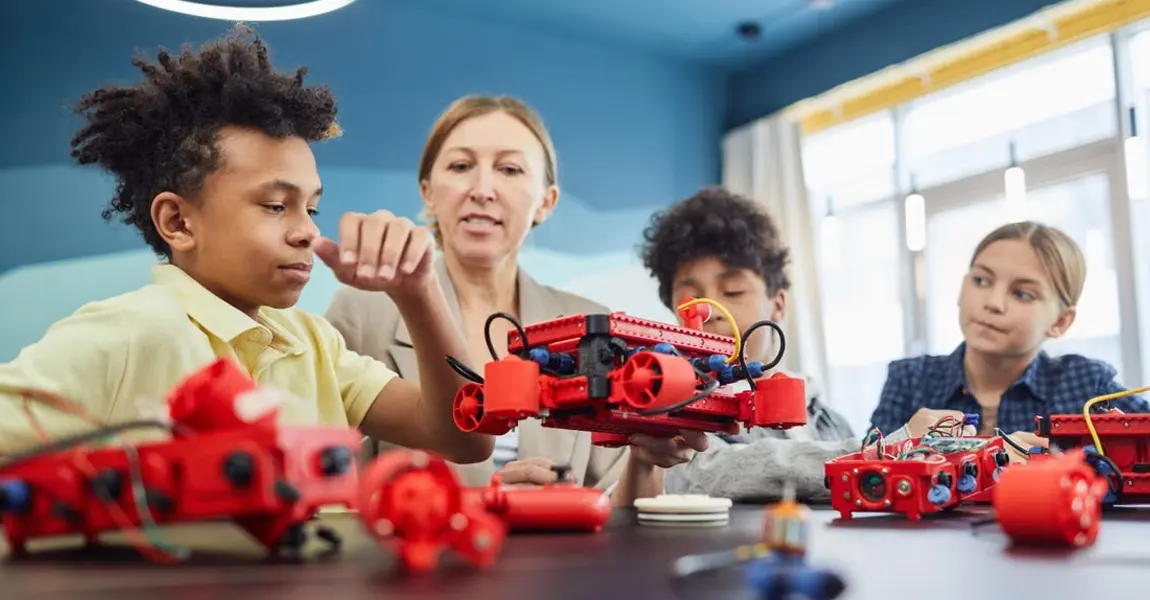
The robotics lab
Something specific happens the first time a machine does what a child told it to do. The code stops being an abstract exercise and becomes a lever on the physical world.
Robotics is useful here less for the robots than for what building them demands. A program either runs or it does not, and the feedback is immediate and completely impersonal. A child debugging their own code learns to look for the fault rather than take it personally, and to keep going after the fourth failed attempt. Persistence is very hard to teach directly. It is much easier to set up conditions where children practise it without noticing.
The woodworking shop
Real tools, real timber, real consequences if you rush. This is one of the few spaces where the safety briefing is not a formality, and children know it.
What surprises visiting parents is how calm the woodworking shop tends to be. Handling a chisel properly requires the kind of slow, deliberate attention that is increasingly rare in a child's day. There is also a very particular satisfaction in a finished object you can pick up and hand to someone. A digital file does not quite do that.
The cooking zone
A kitchen is a maths lesson that punishes guessing. Halve a recipe, misjudge the salt, take the pan off too early, and the result tells you honestly what happened.
More than that, cooking asks a child to make judgement calls. Is this done? Does it need more? Nobody can answer that for them, and after a few weeks they stop asking. That small transfer of authority, from adult to child, is the point of the space.
The tree house and animal rearing zone
This is the quiet end of the hub, and deliberately so.
Caring for an animal is one of the few responsibilities a child cannot negotiate their way out of. The animal needs feeding whether or not it is convenient. Children learn to read another creature's state, to be gentle without being told, and to turn up consistently for something that depends on them.
The tree house serves a different purpose again. Not every part of a learning day should be productive. Children need somewhere to sit, think and be unobserved, and a hub that does not provide that will find they invent it anyway, usually somewhere less safe.
The filmmaking studio and RJ zone
Two spaces, one underlying skill. Both are about finding a voice and then being willing to use it.
In the studio, children write, shoot, edit and screen their work. Collaboration is not optional, because a film cannot be made alone, and neither can the argument about which take to keep. In the RJ zone, they speak into a microphone and then listen back. Almost every child hates the first recording. By the tenth, they are clearer, faster and considerably harder to rattle.
Public speaking anxiety is usually treated as a problem to fix in adulthood. It is far cheaper to prevent it at nine.
The kitchen garden
Gardens run on a timescale nothing else in a child's life does. You water, you wait, and for a long stretch nothing visible happens.
That lag is the lesson. Patience, consistency and the understanding that effort and result are not always same-day events. Children who tend a plot also tend to develop a real interest in where food comes from, which no lesson on nutrition has ever reliably produced.
Why the spaces are the curriculum, not a reward
Most schools have some version of these facilities. The difference is scheduling. In a conventional timetable, hands-on work is what happens on Friday afternoon if the syllabus is on track, which it rarely is.
At Dreamtime, core academics are covered efficiently in small groups, which frees genuine hours every day for this kind of work. Our approach page explains how the academic side is structured to make that possible. The workshops are not a treat at the edge of the week. They are where a good part of the actual learning gets done.
The same thinking shapes our Pune hub, with spaces adapted to that campus and community.
How younger children use these spaces
Parents often assume the labs and workshops are for older learners only. In practice the youngest children in Foundation Fantasy use them constantly, at a different level of complexity. A four year old in the kitchen garden is not studying soil chemistry. They are learning that living things need care, which is the foundation everything else sits on later.
Come and see the mess
Photographs of learning spaces are always taken when they are tidy, which is exactly when nothing is happening in them.
If you want a real sense of the place, the useful visit is mid-morning on a working day, when three projects are half finished and someone is arguing about a design. You can find directions, timings and contact details for the Hyderabad hub, or get in touch through our contact page to arrange a walk-through.
Walk into most schools and you can guess the philosophy from the furniture. Rows facing forward, a board at one end, everything pointed at the adult.
Walk into the hub on Road No. 22 in Jubilee Hills and the first thing that throws people is that there is no front of the room. Children are spread across spaces that look less like classrooms and more like workshops. The noise level is higher than you expect. So, usually, is the concentration.
Here is what is in those spaces, and more importantly, what each one is actually for.
The robotics lab
Something specific happens the first time a machine does what a child told it to do. The code stops being an abstract exercise and becomes a lever on the physical world.
Robotics is useful here less for the robots than for what building them demands. A program either runs or it does not, and the feedback is immediate and completely impersonal. A child debugging their own code learns to look for the fault rather than take it personally, and to keep going after the fourth failed attempt. Persistence is very hard to teach directly. It is much easier to set up conditions where children practise it without noticing.
The woodworking shop
Real tools, real timber, real consequences if you rush. This is one of the few spaces where the safety briefing is not a formality, and children know it.
What surprises visiting parents is how calm the woodworking shop tends to be. Handling a chisel properly requires the kind of slow, deliberate attention that is increasingly rare in a child's day. There is also a very particular satisfaction in a finished object you can pick up and hand to someone. A digital file does not quite do that.
The cooking zone
A kitchen is a maths lesson that punishes guessing. Halve a recipe, misjudge the salt, take the pan off too early, and the result tells you honestly what happened.
More than that, cooking asks a child to make judgement calls. Is this done? Does it need more? Nobody can answer that for them, and after a few weeks they stop asking. That small transfer of authority, from adult to child, is the point of the space.
The tree house and animal rearing zone
This is the quiet end of the hub, and deliberately so.
Caring for an animal is one of the few responsibilities a child cannot negotiate their way out of. The animal needs feeding whether or not it is convenient. Children learn to read another creature's state, to be gentle without being told, and to turn up consistently for something that depends on them.
The tree house serves a different purpose again. Not every part of a learning day should be productive. Children need somewhere to sit, think and be unobserved, and a hub that does not provide that will find they invent it anyway, usually somewhere less safe.
The filmmaking studio and RJ zone
Two spaces, one underlying skill. Both are about finding a voice and then being willing to use it.
In the studio, children write, shoot, edit and screen their work. Collaboration is not optional, because a film cannot be made alone, and neither can the argument about which take to keep. In the RJ zone, they speak into a microphone and then listen back. Almost every child hates the first recording. By the tenth, they are clearer, faster and considerably harder to rattle.
Public speaking anxiety is usually treated as a problem to fix in adulthood. It is far cheaper to prevent it at nine.
The kitchen garden
Gardens run on a timescale nothing else in a child's life does. You water, you wait, and for a long stretch nothing visible happens.
That lag is the lesson. Patience, consistency and the understanding that effort and result are not always same-day events. Children who tend a plot also tend to develop a real interest in where food comes from, which no lesson on nutrition has ever reliably produced.
Why the spaces are the curriculum, not a reward
Most schools have some version of these facilities. The difference is scheduling. In a conventional timetable, hands-on work is what happens on Friday afternoon if the syllabus is on track, which it rarely is.
At Dreamtime, core academics are covered efficiently in small groups, which frees genuine hours every day for this kind of work. Our approach page explains how the academic side is structured to make that possible. The workshops are not a treat at the edge of the week. They are where a good part of the actual learning gets done.
The same thinking shapes our Pune hub, with spaces adapted to that campus and community.
How younger children use these spaces
Parents often assume the labs and workshops are for older learners only. In practice the youngest children in Foundation Fantasy use them constantly, at a different level of complexity. A four year old in the kitchen garden is not studying soil chemistry. They are learning that living things need care, which is the foundation everything else sits on later.
Come and see the mess
Photographs of learning spaces are always taken when they are tidy, which is exactly when nothing is happening in them.
If you want a real sense of the place, the useful visit is mid-morning on a working day, when three projects are half finished and someone is arguing about a design. You can find directions, timings and contact details for the Hyderabad hub, or get in touch through our contact page to arrange a walk-through.
Admissions Open
Share Article


Hyderabad Campus | +91 6302138606
Dreamtime learning hub, Plot no 505, Road no 22, Jubilee hills, Hyderabad – 500033.
Pune Campus | +91 7207352288
Survey no 202A, plot no 4B, next to Shree Hospital, opp Aga khan palace, Kalyani Nagar, Nagar road, Pune – 411006.

hub@dreamtimelearning.com
Copyright © 2026 Dreamtime Learning Hub, All rights reserved.


Hyderabad Campus | +91 6302138606
Dreamtime learning hub, Plot no 505, Road no 22, Jubilee hills, Hyderabad – 500033.
Pune Campus | +91 7207352288
Survey no 202A, plot no 4B, next to Shree Hospital, opp Aga khan palace, Kalyani Nagar, Nagar road, Pune – 411006.
hub@dreamtimelearning.com
Resources
Get in touch
Copyright © 2026 Dreamtime Learning Hub, All rights reserved.
Hyderabad Campus | +91 6302138606
Dreamtime learning hub, Plot no 505, Road no 22, Jubilee hills, Hyderabad – 500033.
Pune Campus | +91 7207352288
Survey no 202A, plot no 4B, next to Shree Hospital, opp Aga khan palace, Kalyani Nagar, Nagar road, Pune – 411006.
hub@dreamtimelearning.com
Copyright © 2026 Dreamtime Learning Hub, All rights reserved.
